What pool deck surface stays coolest in Florida
Everyone selling pool decks says their surface stays cool. Almost nobody publishes a number. Below is the arithmetic, the inputs it uses and where it stops being true, so you can check it against your own deck with a 20 dollar infrared thermometer.
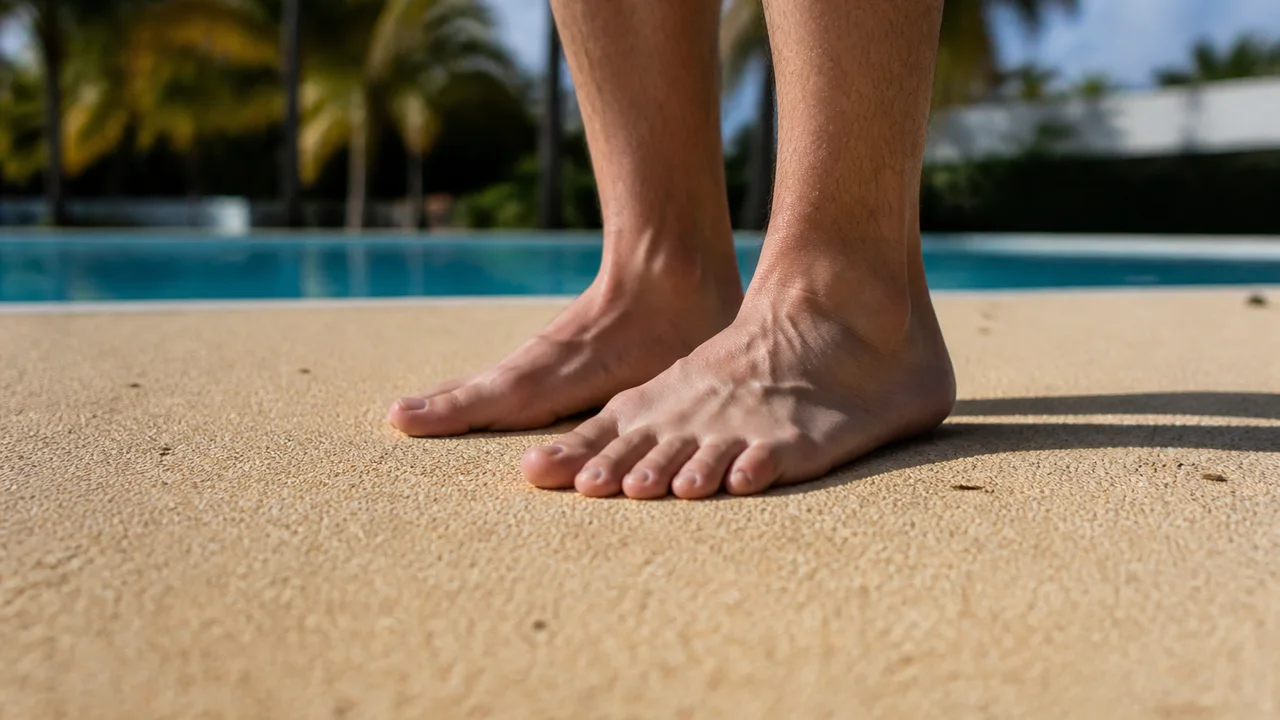
There are 2 temperatures, and only one of them matters barefoot
An infrared thermometer reads surface temperature. That is the number contractors quote. It is not the number that burns you.
What burns you is contact temperature, the temperature at the boundary the moment your skin touches the surface. It sits somewhere between your skin temperature and the surface temperature, and where it lands depends on how fast each material can supply heat. Stone supplies heat fast. Rubber supplies it slowly. That is why a rubber deck and a concrete deck reading the same on a thermometer do not feel remotely the same underfoot.
Surface temperature is decided by color
A horizontal surface in full sun settles where absorbed sunlight equals the heat it sheds to the air and the sky. That balance gives a simple result. The rise above air temperature is proportional to how much sunlight the surface absorbs.
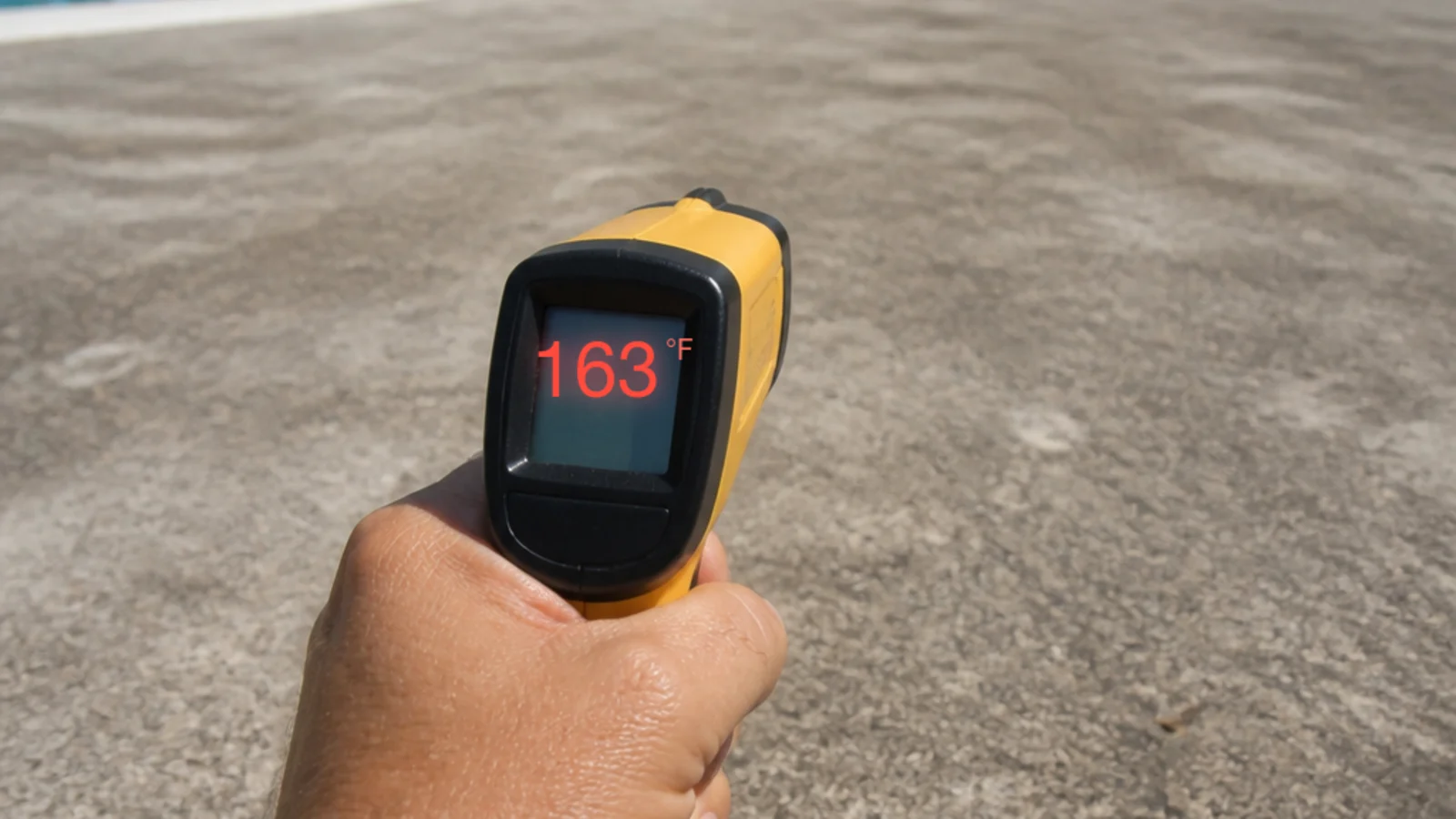
South Florida at solar noon in August delivers roughly 1000 watts per square meter onto a flat deck. With a light breeze a deck sheds heat at roughly 20 watts per square meter for every degree Celsius it sits above air temperature. Divide one by the other and every 10 percent of extra sunlight absorbed adds about 9 degrees Fahrenheit to the surface. A deck that has been down 15 years reflects around 20 percent, not the 35 a fresh pour of concrete would.
Solar absorptance is 1 minus solar reflectance, and reflectance is a property of color, not of chemistry. Here is the same math run for the surfaces a South Florida homeowner actually chooses between, at 91 degrees air temperature.
| Surface | Reflects | Surface temp | Contact temp, barefoot |
|---|---|---|---|
| Black rubber | 5 percent | 176°F | |
| Charcoal paver | 12 percent | 170°F | |
| Aged grey concrete | 20 percent | 163°F | |
| Grey concrete paver | 25 percent | 158°F | |
| Terracotta rubber | 28 percent | 156°F | |
| Light travertine | 40 percent | 145°F | |
| Tan rubber | 45 percent | 140°F | |
| Light sand rubber | 60 percent | 127°F |
Under the pain lineOver the pain lineSkin registers pain from about 111 degrees
Read the first two columns and the honest conclusion is uncomfortable for anyone selling rubber. A dark rubber deck is not a cool deck. Black absorbs 95 percent of the sunlight that lands on it and reads 176, hotter than the 163 degree concrete it went over. Anyone who tells you rubber is cool regardless of color has not put a thermometer on one.
Contact temperature is why rubber wins barefoot
Now read the last column, and the picture inverts.
When skin touches a surface, the boundary temperature is set by which side can deliver heat faster. The property that governs it is thermal effusivity, and it varies enormously between these materials. Dense concrete sits around 1760 in the usual units. Travertine and natural stone are higher still, near 2050. A porous bound rubber wear layer is around 420, roughly a quarter of concrete. Skin is about 1180.
Put a 91 degree foot on 163 degree concrete and the boundary lands at about 134 degrees, because the concrete wins the exchange and drags your skin up toward its own temperature. Put the same foot on 156 degree terracotta rubber, a hotter surface by the thermometer, and the boundary lands at about 105 degrees, because the rubber cannot resupply heat fast enough and the skin wins.
That 29 degree gap is the whole answer to why people describe rubber as cool underfoot while an infrared gun says otherwise. Both things are true at once.
| Material | Thermal effusivity | What your foot feels |
|---|---|---|
| Travertine and natural stone | About 2050 | 125 degrees F |
| Dense concrete | About 1760 | 134 degrees F |
| Skin | About 1180 | Reference point |
| Bound rubber wear layer | About 420 | 99 to 110 degrees F |
Effusivity, not surface temperature, decides what burns you. Stone supplies heat faster than skin can carry it away. Rubber cannot, so every rubber blend lands under the pain line.
Where the burn threshold sits
Skin registers pain from contact somewhere around 111 to 116 degrees. Sustained contact above about 118 degrees is where tissue damage starts, and the time it takes shortens fast as the number climbs.
Set that against the last column. Concrete at 134, pavers at 132 and 139 and travertine at 125 are all above the line, which is why children sprint across them and why a dropped towel becomes a stepping stone. Every rubber row lands between 99 and 110. A light sand blend comes in under 100, which is barely above body temperature. A light or mid blend is not merely more pleasant, it is on the safe side of a physiological line that every stone finish is on the wrong side of.
What this means when you pick a color
Three practical conclusions come out of the table.
First, for a deck in full sun that gets walked barefoot, choose a light or mid blend. Sand, tan, light grey and terracotta all land in the safe band. We steer people there and we will say so at the estimate, even when a customer arrives asking for charcoal.
Second, dark blends are fine where they are not walked barefoot at midday. A driveway, a walkway under tree cover, a court, a lanai under a solid roof. Shade removes the direct sunlight term entirely and the whole table collapses toward air temperature.
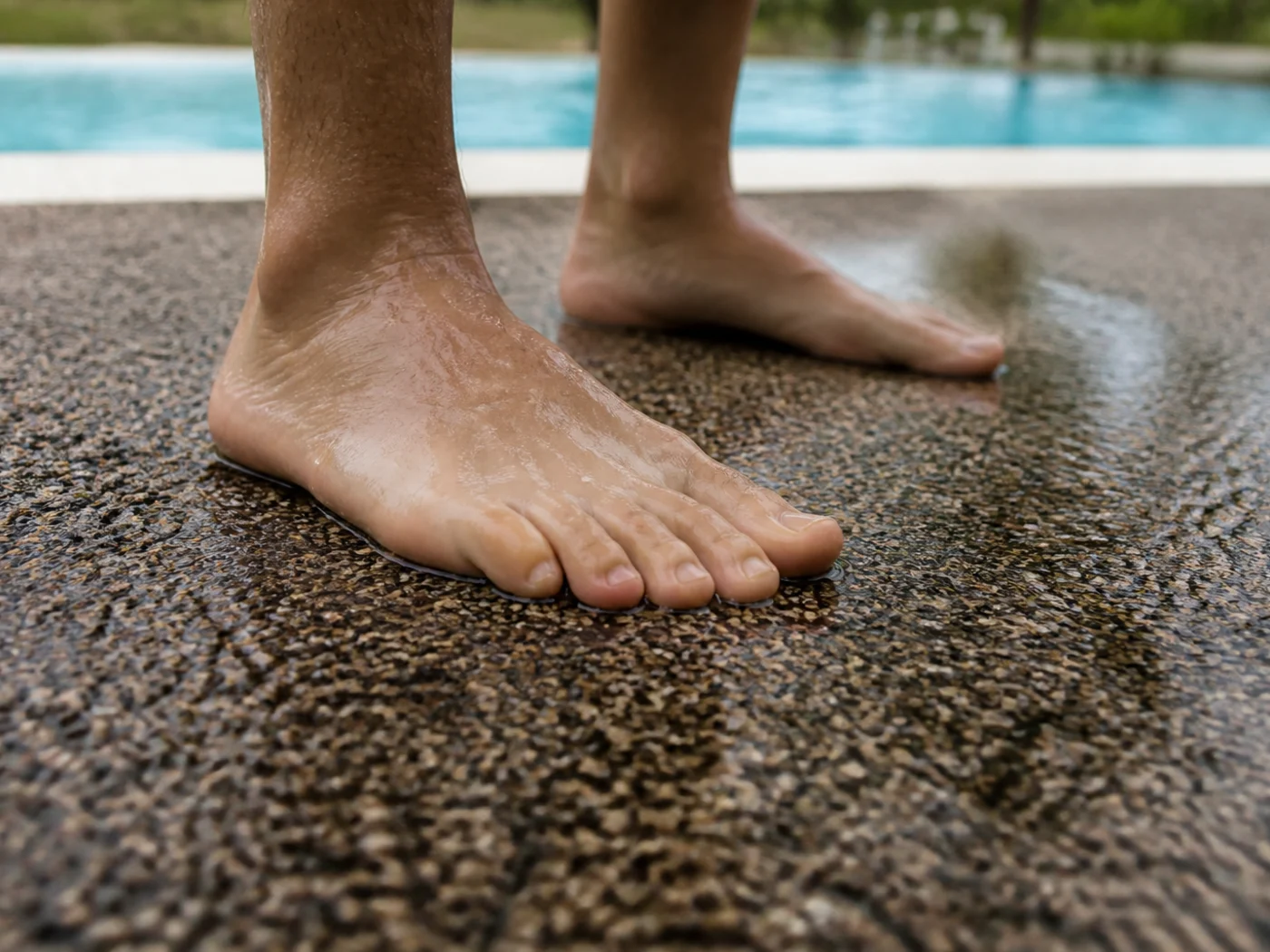
Third, the porous structure adds a second cooling effect this arithmetic does not include. After rain or splash out, water sits inside the wear layer rather than on top, and evaporation pulls the surface down further for as long as it stays damp. A sealed stone deck sheds the water and loses that.
Check it on your own deck
None of this needs to be taken on trust. An infrared thermometer costs about 20 dollars. Point it at your deck at 1 pm on a clear August day, note the air temperature, and compare against the table. The surface temperature is easy to verify. Contact temperature you can verify with your hand, which is what the argument was about in the first place.
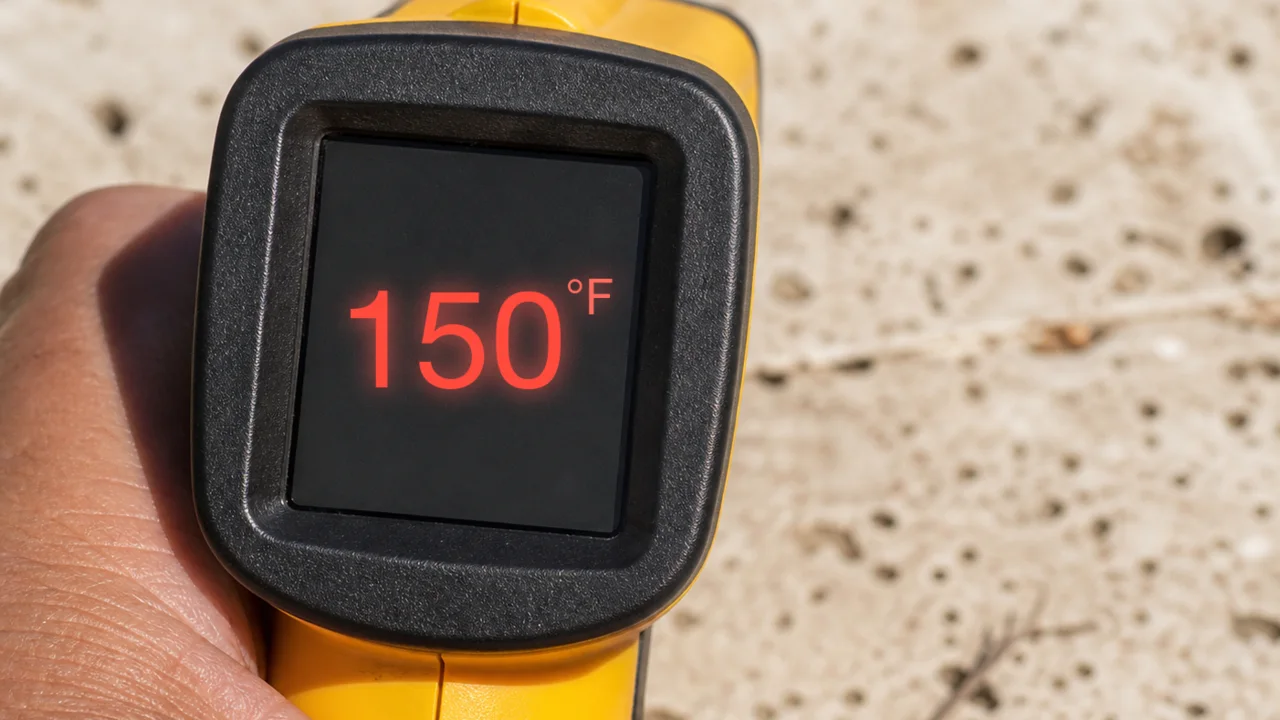
These figures are calculated from published solar reflectance and thermal property values for each material, not measured on a specific deck. Real decks vary with slab color underneath, wind, humidity, cloud, shade and how recently it rained. We are publishing the method rather than a marketing number so you can argue with it.
 Grip when the deck is wet
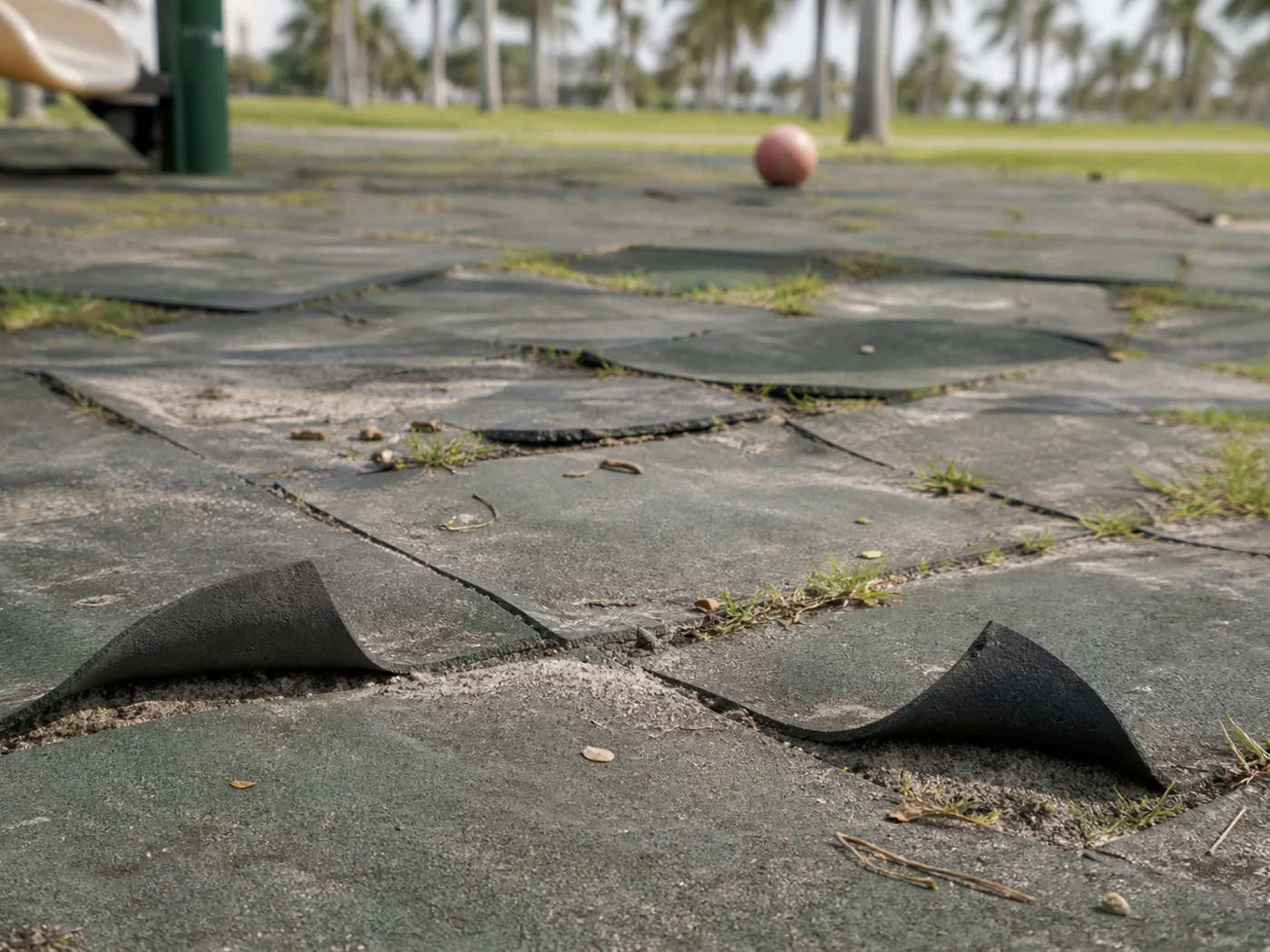 Poured rubber against tiles
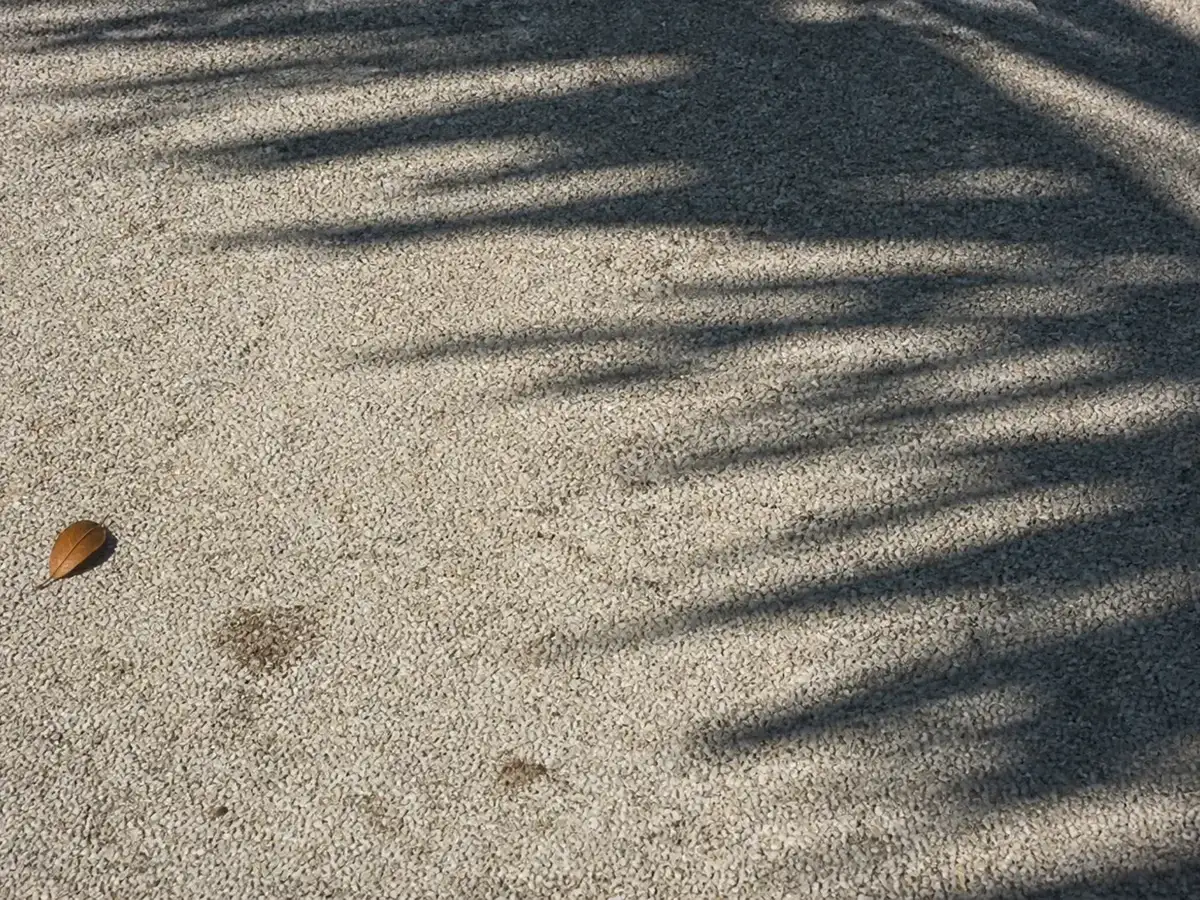 Stone carpet in Florida heat